Burnout Prevention for Leaders: A CEO's Practical Playbook for Staying Sharp

An executive office moment that captures the quiet pressure of constant decisions, created with AI.
You can run a company on adrenaline for a while. The numbers might even look fine. But eventually, the body sends an invoice.
Burnout prevention for leaders starts with one hard truth: burnout isn't "I'm tired." It's ongoing stress that drains focus, mood, and health until you start leading on fumes. The scary part is how normal it can feel. You still show up. You still perform. You just do it with less patience, less joy, and more friction.
And it's not only personal. Stress at the top leaks into the business. When you're running hot, you miss details, make sharper calls than needed, and create silent churn in the room. Over time, that can mean more mistakes, lower output, and higher turnover.
This isn't a "move to the woods" plan. It's a simple, practical approach you can start this week. It also respects reality: most wellness tools get ignored. Leaders and teams adopt habits when they fit the day, especially when they're small, guided, and easy to repeat.
Spot burnout early, before it shows up in the numbers

Photo by Nataliya Vaitkevich
CEOs miss early burnout signals for the same reason they got promoted. You normalize pressure. You hide strain. You power through.
Besides, leadership often rewards the exact behaviors that mask the problem. Longer hours look like commitment. Being "always available" looks like care. Skipping recovery looks like grit.
Still, burnout leaves clues across four areas:
- Body: lighter sleep, tight jaw, headaches, stomach issues, more caffeine, more late-night snacking.
- Mind: foggy focus, slower recall, racing thoughts, decision fatigue by noon.
- Behavior: shorter temper, avoidance of hard conversations, more scrolling, less movement.
- Leadership style: more control, less listening, more urgency, fewer calm decisions.
If you want a deeper list of CEO-specific signs that often get dismissed, this overview is a helpful mirror: CEO burnout warning signs and prevention ideas.
Burnout rarely starts as collapse. It starts as small "this is fine" moments that repeat until they become your personality.
The CEO burnout signals that look like "good leadership"
Some burnout signals come dressed as praise.
You answer Slack at 11:47 p.m. People call you responsive. You skip lunch and keep rolling. People call you driven. You carry the whole board deck alone because "it's faster." People call you accountable.
Then the cost shows up in tiny leadership fractures. You misread a key metric in a meeting because your brain is jumping tracks. You forget the one slide that legal needed, because you rushed. You snap in a 1:1, then spend the evening replaying it. Meanwhile, your team stops bringing early problems to you, because your tone feels sharp.
Even your best traits can flip when you're depleted. High standards turn into impatience. Speed becomes sloppiness. Confidence becomes "I can handle it" thinking, even when you can't.
If you're not sure whether you're seeing stress or burnout, scanning a symptom-focused guide can help you name it faster, for example: 9 CEO burnout symptoms to recognize.
A 2-minute weekly check-in that keeps you honest
You don't need a complex system. You need a repeatable moment of truth.
Once a week, same day, same time, open Notes and rate these from 1 to 10. Keep it simple and blunt. No storytelling.
Here's a quick template:
| Check-in item | Rate 1 to 10 | Quick note (one line) |
|---|---|---|
| Sleep quality | ||
| Irritability | ||
| Focus | ||
| Recovery after stress | ||
| Joy (yes, joy) |
Then add one question that cuts through excuses: "What did I sacrifice this week that I can't keep sacrificing?"
That question matters because leaders can trade away health in quiet ways. Movement. Family dinners. Deep work. Even the ability to think slowly. Over time, you don't just feel worse, you lead worse.
Build a burnout-proof calendar, because willpower won't save you
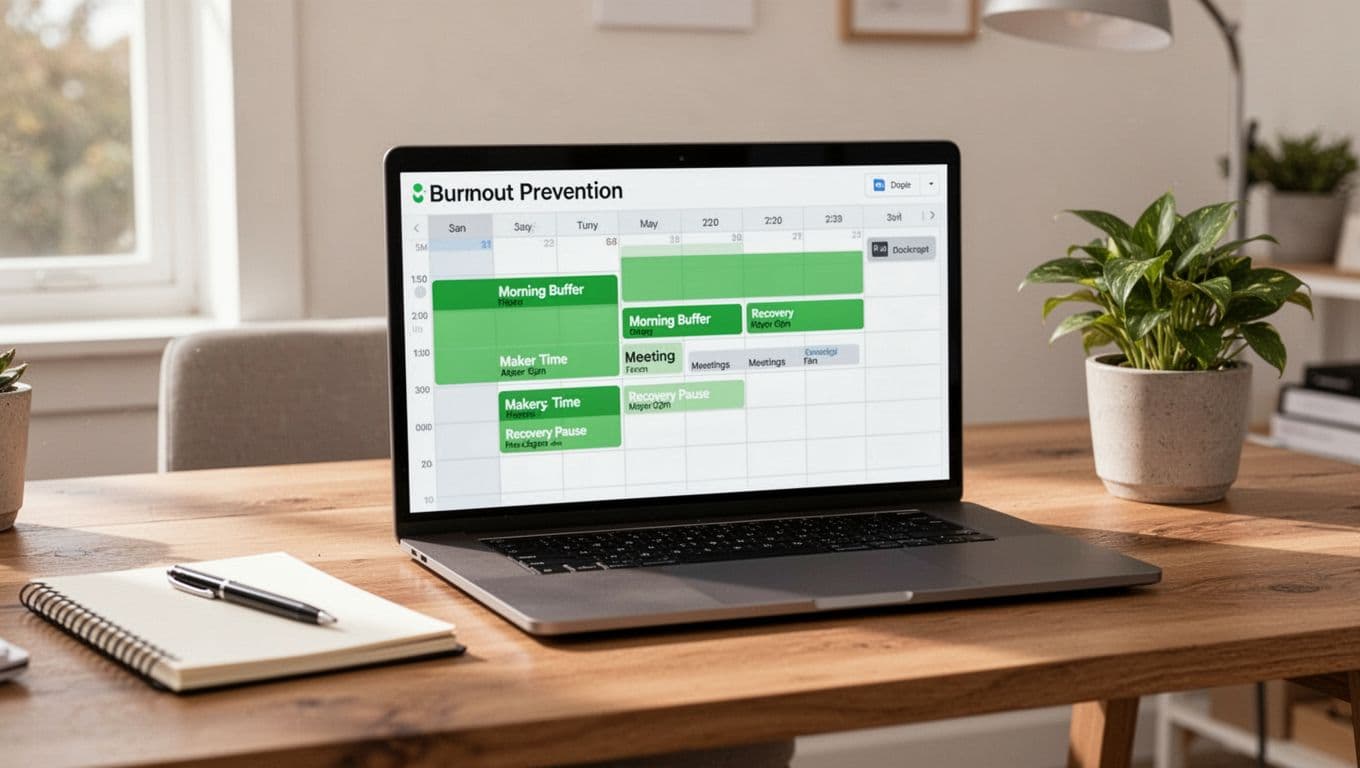
A time-blocked calendar that protects attention and recovery, created with AI.
A CEO's schedule is a machine that prints stress. If you don't design it, it designs you.
Burnout prevention is mostly about structure, not motivation. You can't "try harder" to recover. Recovery has to be scheduled, protected, and easy to keep even on rough weeks.
If you want CEO-specific calendar and workload ideas, this piece offers solid framing: strategies to avoid CEO burnout. The key is turning strategy into defaults your assistant, your team, and your future self can follow.
Protect your mornings, then your margins, then your sleep
Start with three layers, in this order:
First, a morning buffer (30 to 60 minutes, no meetings). Use it for thinking, writing, or a short walk. Your brain is usually clearest before the day gets loud.
Next, meeting margins (5 to 10 minutes between calls). Those gaps aren't wasted. They're where your nervous system settles. Without them, you stack stress like plates until something drops.
Finally, a real shutdown time. Not "I'll stop after this last email," because there's always one more. Pick a time that's realistic, then make it a norm.
Weekend recovery helps, but it's a slow refill. Daily recovery is the fast one. It keeps a hard meeting from wrecking the next three.
Turn meetings into lighter loads, not daily endurance tests
Meetings often become endurance tests when they lack a clear point.
Try these CEO-friendly rules for the next 30 days:
Keep attendance tight, because every extra person adds noise. Assign an owner, because "we" means nobody. Ask for an agenda in three bullets, because long agendas get ignored. Label the meeting as Decision or Update, because the brain prepares differently.
Also cap recurring meetings. If no decisions are expected, cancel by default. You can always bring it back when reality demands it.
Most importantly, protect "maker time." Deep work is not a luxury for leaders. It's where strategy gets born, where messy ideas get cleaned, and where you regain calm focus.
Use micro-recovery to reset your nervous system in real time

A leader using breathing to reset between demands, created with AI.
Stress is not only a thought. It's physical. Your heart rate shifts. Your breath gets shallow. Your shoulders creep up toward your ears.
That's why "just relax" doesn't work. The body needs a physical signal that says, "You're safe right now."
This is where guided breathing fits a CEO's reality. It's fast. It's private. It doesn't require a yoga mat or a perfect morning. Even three to five minutes between meetings can change how your body feels, which changes how your mind responds.
If you want a simple, guided option that's built for real life, not long meditation sessions, download Pausa. It's designed to help people lower stress and anxiety through short breathing sessions, plus features that reduce screen time instead of feeding it. It also carries a human story behind it, it was created after panic attacks pushed its founders to find practical relief, not complicated rituals.
For a quick, mainstream take on how short breathing techniques can shift stress fast, this is an accessible read: a 5-second breathing technique for stress.
A simple breathing plan for the moments that usually break you
Most leaders don't need "more habits." They need a plan for the exact moments that tip them over.
Use a "when this, then that" playbook:
- Before a tough call: choose a calming pattern, like box breathing, to slow the internal rush.
- After conflict: downshift with slower, steadier breaths so you don't carry heat into the next meeting.
- Mid-afternoon slump: use an energizing option (some people like Wim Hof-style breathing) instead of another coffee.
- Before sleep: wind down with gentle breathing so the day doesn't replay at midnight.
Keep it guided when you're stressed. In tense moments, your brain wants the simplest path. Audio guidance removes the friction and gives you companionship when you'd otherwise white-knuckle it alone.
Make your phone help you pause, not pull you under
Your phone can be a tool, or it can be a trap door.
Doom-scrolling often shows up when your brain wants relief but can't find it. It looks like "a quick break," but it usually leaves you more tense and less present. Then you bring that fuzziness into dinner, into bedtime, and into tomorrow's first meeting.
Add gentle friction. Put social apps one screen away. Turn off non-human notifications. Better yet, use tools that interrupt the loop with a small pause, so you can choose what happens next.
Small pauses add up. Five minutes can shift your body. A few steady breaths can change your tone. Over weeks, those micro-resets build a calmer relationship with your thoughts, and with your phone.
Prevent team burnout by changing what your leadership rewards
Even if you become a recovery expert, your company will still mirror what you reward.
If your culture praises speed above all, people will hide exhaustion. If you treat urgency as a personality, your leaders will copy it. Besides, burnout spreads fastest in silence.
Research and advisory groups have tracked how uncertainty and pressure hit CEOs and their organizations, and how resilient leaders respond with clearer wellness priorities. This Vistage perspective is useful context: CEO burnout prevention during uncertainty.
Stop rewarding urgency, start rewarding clarity and recovery
Start by defining "urgent." If everything is urgent, nothing is.
Set response-time norms, even for leaders. For example, "If it's not marked urgent, expect a response within 24 hours." Then model it yourself. When you reply instantly at midnight, you teach people to stay on edge.
Praise clean handoffs. Celebrate clear writing. Reward leaders who simplify, not only those who sprint.
Protect PTO with actual coverage plans. Also normalize breaks after intense moments. You can say it out loud in an all-hands: "After a hard client call or a tough incident, take 10 minutes. Reset, then come back."
When recovery is permitted, people think better. When recovery is praised, people stay longer.
Offer a tool people will actually use, with privacy built in
Wellbeing programs fail when they feel like homework. Adoption matters more than a fancy feature list.
Look for tools that work with zero training, fit into five-minute windows, and respect privacy. Employees won't use anything that feels like surveillance.
That's why guided breathing tends to land well. It meets people where they are, stressed, unfocused, anxious, tired, and gives them something they can do right away. It also avoids the pressure of meditation for people who don't meditate.
For organizations that want a practical B2B2C option, Pausa Business gives each employee access to guided breathing on iOS and Android, with engagement designed for real days. Teams can use short sessions from day one. The platform includes mood-based recommendations that adapt to how someone feels, streaks that help habits stick together, and reporting built on fully anonymized data. The point isn't to collect personal details. The point is better focus, lower perceived stress, and fewer burned-out weeks.
Conclusion: Lead like recovery matters, because it does
Burnout prevention for leaders isn't mysterious. It's repeatable.
Spot early signals before they hit performance. Design your calendar so recovery happens during the day. Use micro-recovery, especially guided breathing, to reset in real time. Then shape culture by rewarding clarity, boundaries, and healthy pace.
Pick one change today and schedule it. Put it on the calendar like a board meeting. Your energy is a business asset, and it's worth protecting.