Breathwork for Better Sleep: Practical Breathing Patterns That Quiet a Busy Mind
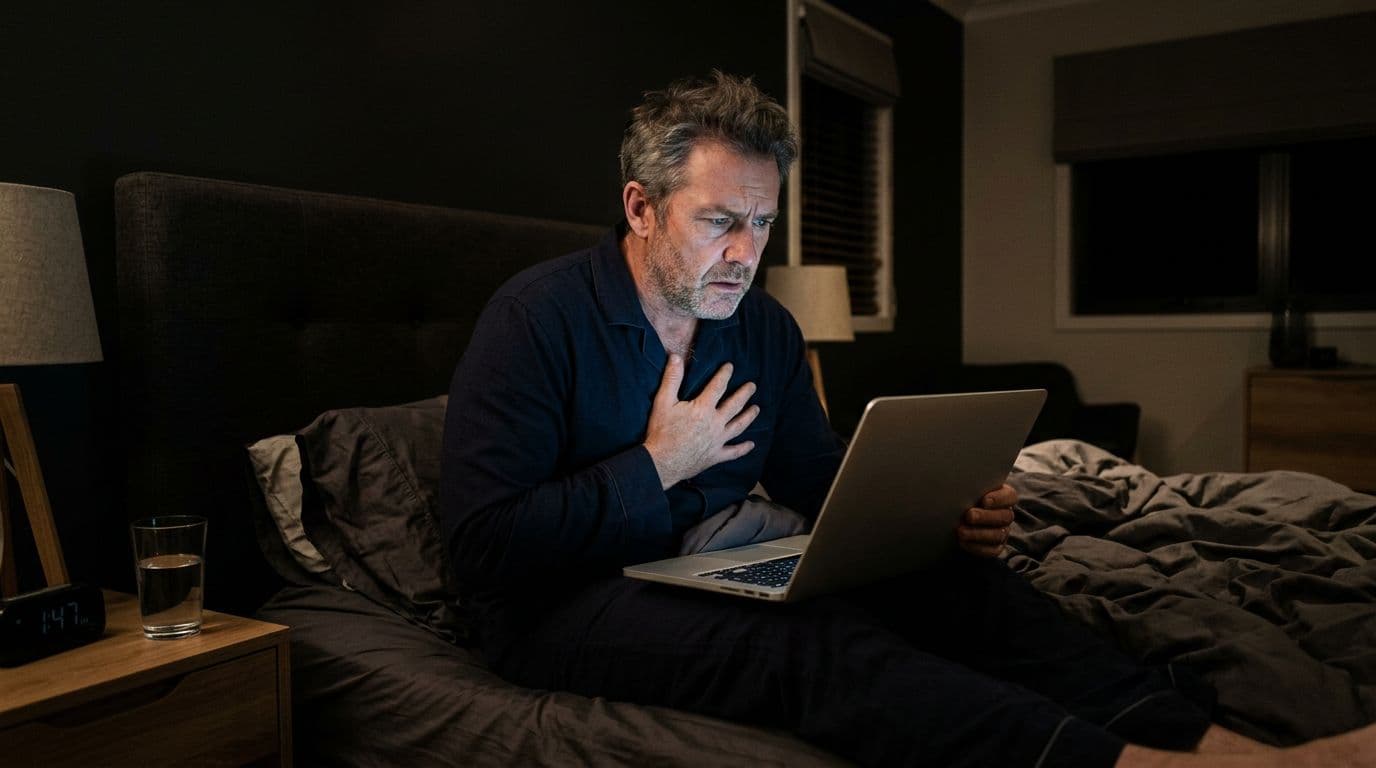 Late-night work stress can keep the body on alert, even after the day ends (created with AI).
It's 11:48 p.m. You close the laptop, but your body doesn't believe the day is over. Your chest feels tight. Your jaw is still set. Your brain keeps replaying that last meeting like it's trying to "solve" it.
That's where breathwork for better sleep earns its place. In plain terms, breathwork is guided breathing patterns that help your body shift into rest. Not a long meditation. Not a perfect nighttime routine. Just a few minutes of breathing that tells your nervous system, "You're safe now."
If you lead a company, this matters twice. First for your own sleep, because decision fatigue doesn't stop at bedtime. Second for your team, because burned-out, under-slept people can't do their best work, no matter how talented they are.
Why breathwork helps you sleep, even when your mind is loud
Stress turns on the body's alarm system. That alarm system changes your breathing fast. It gets shallow. It climbs into the chest. Then your heart rate follows, and the mind starts scanning for problems.
Breathwork works because breathing is one of the few "levers" you can pull on purpose. Slow breathing, especially with a longer exhale, nudges the body toward parasympathetic rest mode. In everyday language, it helps your system stand down.
You'll also hear people mention heart rate variability (HRV). You don't need to track it. The point is simple: calmer breathing tends to pair with calmer physiology, and calmer physiology tends to pair with better sleep.
Recent research keeps landing in the same direction. A 2025 mini-review in Frontiers in Sleep summarizes how breathing exercises can improve sleep quality across adult groups, especially when practiced consistently over weeks, not once in a crisis. See the overview in this Frontiers review on breathing exercises and sleep quality.
The sleep problem most leaders ignore: your body is still "on duty"
Work stress doesn't vanish when you brush your teeth. It hides in the body. You notice it as faster breathing, restless legs, a "busy" stomach, and a mind that keeps drafting tomorrow's emails.
In the US, the problem is big and common. Only about 65% of adults reliably get the recommended 7+ hours of sleep, and estimates suggest more than 43% of US workers are sleep-deprived. Many also sit most of the day, which has been linked with more insomnia symptoms. Those patterns show up at night as broken sleep and early wake-ups.
For companies, poor sleep isn't just personal. Fatigue increases mistakes and irritability. It raises conflict. It weakens memory. It also costs real money through missed days and reduced output. A typical mid-sized employer can lose serious annual dollars to fatigue-related presenteeism alone.
What changes first when you slow your exhale
If you only remember one rule, remember this: lengthen the exhale.
A longer exhale acts like a safety signal. It slows the heart rate and reduces that "on alert" feeling. You often feel the shift before you can explain it. Shoulders drop. The breath gets quieter. Eyelids feel heavier. Your thoughts stop sprinting.
When sleep won't come, don't fight the mind first. Calm the body, and the mind often follows.
Even 5 to 10 minutes can help. The bigger gains usually come from repetition, the same way physical training works. That's why "small pauses" can add up to real change.
For a simple, mainstream explanation of the breath-sleep connection, see this Psychology Today piece on breathwork and sleep.
A simple bedtime breathwork routine you can do in 5 minutes
This is built for tired brains. You can do it in bed. No special posture. No incense. Just a low-friction reset.
Before you start, set the scene: lights low, phone face down, and the room slightly cool if possible. Then take five minutes.
- Get comfortable (20 seconds). Lie on your back or your side. Let your tongue rest. Unclench the hands.
- Breathe in gently through the nose (about 3 to 4 seconds). Keep it quiet, like you're trying not to wake anyone.
- Exhale longer (about 6 to 8 seconds). Let the exhale feel like a slow "deflation."
- Count 10 breaths. If you lose count, return to "one" without judging it.
- Finish with two easy breaths. Then stop "doing" the practice and let sleep take over.
Distraction will happen. That's normal. Each return to the count is the point, because it trains your attention to come back to the body.
Most people notice the best changes after a few weeks of daily practice, not after one perfect night. That lines up with how many sleep interventions work in the research literature: repetition beats intensity.
Start here: diaphragmatic breathing for a quiet, heavy body
 Diaphragmatic breathing helps the body feel steady and grounded before sleep (created with AI).
Diaphragmatic breathing is "belly breathing," but don't force it. Think soft and steady.
Place one hand on your belly and one hand on your chest. Breathe in through the nose. Let the belly rise first, like a balloon filling low. Then exhale slowly and feel the belly fall.
Common mistakes are easy to fix:
- If your shoulders lift, shrink the inhale. You don't need a big breath.
- If you feel air hunger, slow down less. Keep the rhythm comfortable.
- If you get tense, relax the jaw and make the exhale quieter.
Why it helps: this style reduces upper-chest breathing, which often shows up with anxiety. It also creates a steadier rhythm, which makes it easier to drift.
Try 4-7-8 when you feel wired and can't shut off
The classic pattern is simple: inhale for 4, hold for 7, exhale for 8. The sleep "lever" is still the long exhale.
If those counts feel too intense at night, use a beginner-safe version: inhale 3, hold 3, exhale 6. You'll still get the longer exhale, without the strain.
Do 4 rounds. Then switch to normal breathing.
A quick safety note: if you feel dizzy or uncomfortable, return to regular breathing. Breathwork should feel calming, not like a challenge.
Match the breathing technique to your sleep issue
Not all insomnia feels the same. Sometimes your mind races. Sometimes you wake at 3 a.m. Sometimes you're calm, but your body still buzzes after conflict.
This quick map helps you choose fast:
| Sleep problem | Best-fit breathwork | Why it helps |
|---|---|---|
| Racing thoughts at bedtime | Box breathing | Predictable rhythm steadies attention |
| Body feels "wired" | 4-7-8 (or 3-3-6) | Longer exhale helps downshift |
| Middle-of-the-night wake-up | Gentle longer-exhale reset | Reduces the adrenaline loop |
| Post-meeting stress in the body | Resonant slow breathing (about 5 to 6 breaths/min) | Smooths breathing rhythm and tension |
| Need a fast calm switch | Physiological sigh (cyclic sighing) | Quick release of built-up tension |
The takeaway is practical: you don't need one perfect method. You need the right tool for the moment.
For readers who want a deeper look at breathwork's effects on stress and physiology, a 2025 trial in Scientific Reports explored psychophysiological changes from breathwork practices. You can skim it here: Scientific Reports trial on breathwork effects.
If your thoughts race: box breathing to steady your attention
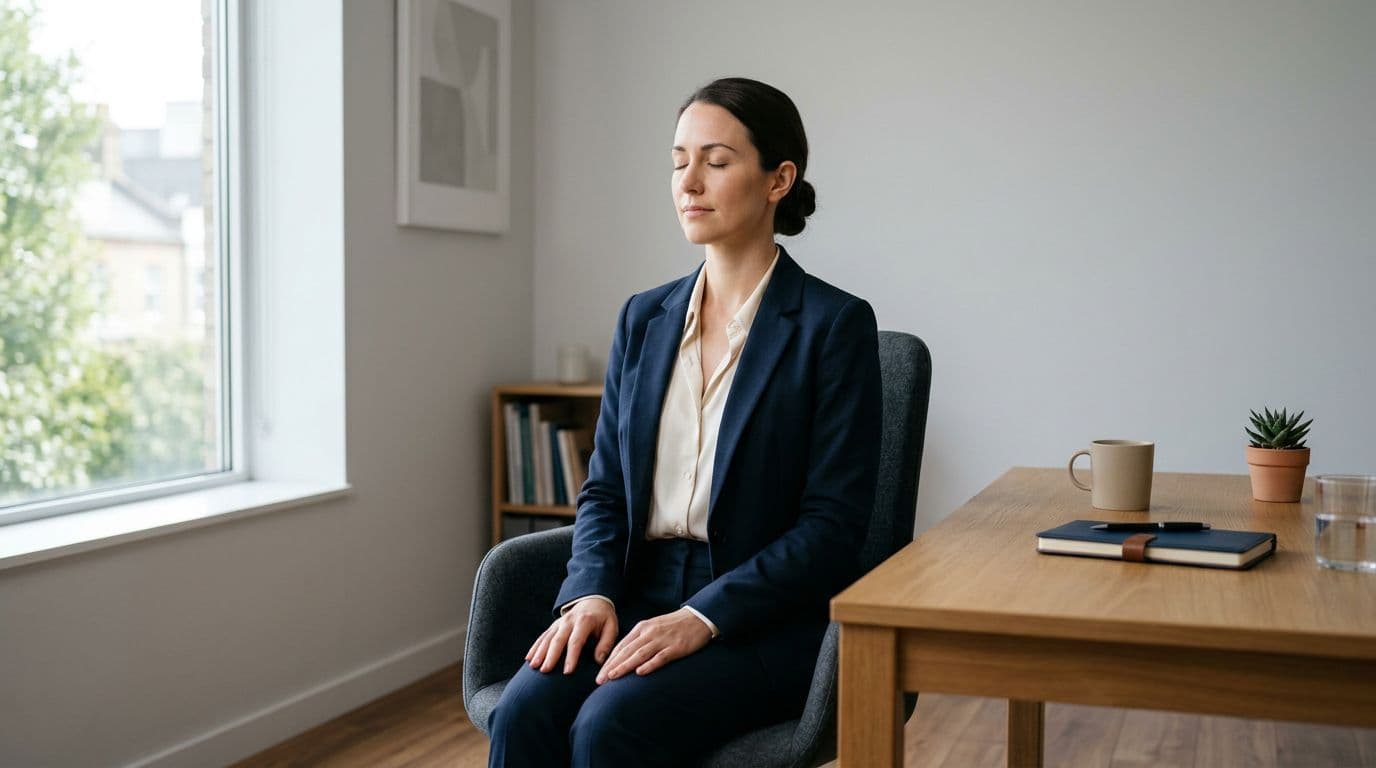 Box breathing is a simple rhythm you can use after intense work, and later in bed (created with AI).
Box breathing is a square: inhale, hold, exhale, hold, all the same count.
Try: inhale 4, hold 4, exhale 4, hold 4. Repeat for 2 to 4 minutes.
This helps because the mind likes a clean pattern. The counting gives your attention one job. As a result, it pulls you out of mental loops.
For leaders, this is especially useful after late meetings. Use it as a "doorway practice." Do it before you walk into your home, or before you step into the bedroom. That way you don't bring the room home with you.
If you wake up at 3 a.m.: use a gentle "longer exhale" reset
When you wake in the middle of the night, the biggest risk is adding fuel. Bright screens, checking the clock, and starting a mental debate about tomorrow can lock you in.
Instead, keep it boring and dark.
Close your eyes. Inhale for 3 to 4 seconds. Exhale for 6 to 8 seconds. Do that for 2 to 3 minutes. If you want a small anchor, lightly count the exhales only.
This works because middle-of-the-night wake-ups often come with a stress spike. The longer exhale signals safety. It can also break the "adrenaline loop" where one wake-up becomes a full hour of alertness.
If physical tightness plays a role, some bodywork research is also exploring diaphragm-related approaches and sleep outcomes. For context, see this BMC Pulmonary Medicine pilot on diaphragm release and sleep quality.
Make breathwork stick in real life, and scale it across your company
The best sleep tip in the world fails if it becomes another chore. So keep it small. Make it normal. Then let it grow.
This is also where company culture matters. When leaders treat recovery like a private weakness, employees hide their stress until it leaks. On the other hand, when leaders normalize short resets, people use them without shame. Sleep improves because evenings become less "loaded."
Pausa's story fits this reality. It was built after real panic attacks, when breathing felt impossible and the need was urgent. The solution wasn't complicated, and it wasn't a long meditation. It was short, science-backed breathing that people could do in real life, then continue their day.
If you want language that makes stress management feel grounded (not fluffy), this piece can help: practical stress management for interviews. The same "process over bravado" approach works in leadership, too.
Your personal plan: one trigger, one 5-minute practice, one week
Pick one trigger you already do every night. For example, brushing your teeth, locking the front door, or putting your phone on the charger. Then attach a 5-minute practice to it.
Choose one method for seven nights:
- Diaphragmatic breathing if you feel tense.
- 4-7-8 (or 3-3-6) if you feel wired.
Track it in the simplest way possible. A note on your nightstand works. A streak can help, but don't turn it into pressure. The win is consistency, not perfection.
Make the practice easy enough for your worst day, not your best day.
A practical benefit leaders will notice first: fewer sharp edges, better mornings
Better sleep doesn't always show up as "more energy." Often, it shows up as fewer sharp edges.
You pause before reacting. You decide faster. You don't reread the same paragraph six times. You handle conflict without carrying it for hours. Those changes protect your team, because your nervous system sets a tone others can feel.
In demanding roles, fatigue also increases the odds of preventable mistakes. That's true in healthcare, transportation, and high-stakes knowledge work. Put simply, sleep is a performance system, not a luxury.
Use guided breathwork so employees don't have to "figure it out"
Some people won't practice if they have to plan it, time it, and second-guess it. That's why guided breathwork helps. It removes friction. It also adds a sense of companionship, especially for people who feel alone with their stress at night.
Pausa is designed for that. Sessions are short, guided by audio, and built around science-backed patterns like box breathing and resonant slow breathing. It also supports mood-based recommendations, so people can choose a quick calm reset, a focus reset, or a wind-down.
If you want an easy starting point, download the app here: Pausa (English).
Bring it to the whole team with Pausa Business
If you're responsible for wellbeing at scale, you need a program that respects privacy and doesn't require hours of training. Pausa Business follows that model.
A low-friction rollout looks like this: the company provides access, employees use private 5-minute resets during the day, and teams can optionally build streaks together. Leaders get engagement insights at an aggregate level, while individuals keep their personal feelings personal. Admin tools help manage licenses without creating extra work.
The goal isn't to "fix" people. The goal is to reduce perceived stress, improve focus, and make it easier to downshift at night. When evenings feel calmer, sleep becomes more reachable.
For additional context on how breathing practices can support mood and stress symptoms, a 2026 randomized trial in Scientific Reports explored outcomes from breathing exercises in a clinical population. Here's the source: Scientific Reports RCT on breathing exercises.
Conclusion
Tonight, keep the room quiet and the lights low. Then breathe in gently, and exhale longer than you inhale. Let that be the signal that the day is done.
Three ideas matter most: breathwork helps downshift the stress response, five minutes is enough to start, and matching the technique to the problem makes it easier to follow through. Pick one routine for a week, and watch what changes first, your sleep, your mornings, and the way you show up at work. If you lead a team, consider making guided breathwork available company-wide so recovery becomes normal, not rare.